At first glance, the Devon Rex and the Sphynx could hardly look more different: one wears a soft, wavy coat, the other appears to wear no coat at all. Spend time with them, though, and the similarities are striking. Both are warm-seeking, people-obsessed, playful cats that want to be on you, near you, or at least in the same room as you. Both came from a natural genetic mutation, and both need more skin and temperature care than an ordinary cat. This comparison covers coat, grooming, warmth, health screening and daily life — the things that actually decide whether either breed fits your home — without declaring a winner, because the right answer depends on how much hands-on care and company you can give.
Origins and appearance
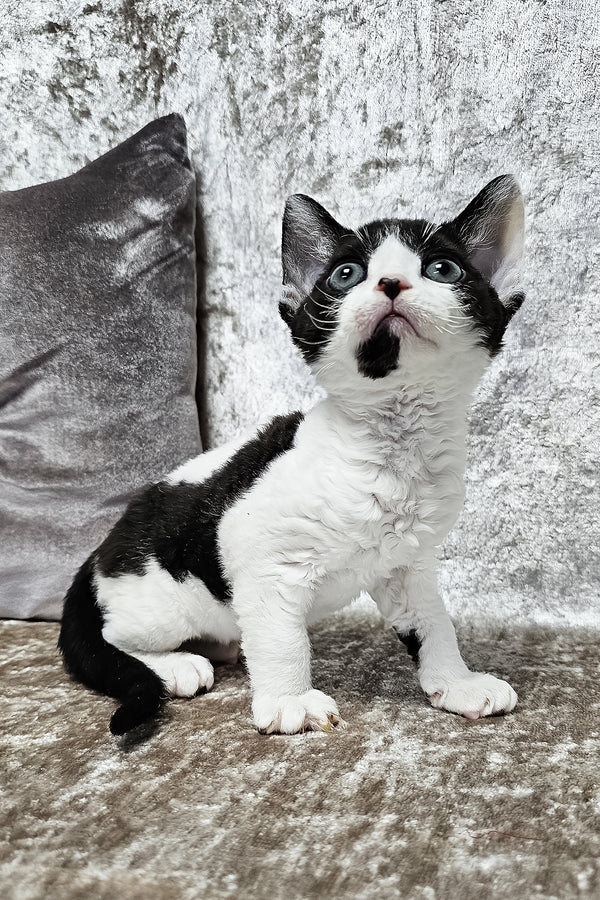
The Devon Rex appeared in Devon, England, in 1960, when a curly-coated kitten was born in a litter of otherwise ordinary farm cats. The curl came from a recessive gene that changes the hair structure, and breeders developed the breed from that single kitten. The result is a small-to-medium cat with a slender body, a wedge-shaped head, huge low-set ears, large oval eyes and a short coat of soft waves and curls. The coat is often described as feeling like suede or crushed velvet. Adult Devon Rex cats commonly weigh around 2.5–4.5 kg, and their elfin, almost pixie-like face gives them a permanently mischievous expression.
The Sphynx appeared in Toronto, Canada, in 1966, when a hairless kitten was born to an ordinary domestic shorthair. That kitten, too, carried a recessive gene mutation, and breeders developed the breed from it. The Sphynx is a medium-sized, muscular cat with a rounded, barrel-like body, a wedge-shaped head, very large ears, lemon-shaped eyes and skin covered in fine down that feels like warm suede or peach skin. Wrinkles are normal, especially around the head and shoulders, and the skin shows colour and pattern just as a coat would. Adult Sphynx cats commonly weigh around 3.5–5.5 kg.
Both breeds are recognised by the major registries, including TICA, the CFA, the GCCF and FIFe, and both are the product of a single mutation that breeders developed carefully.
Temperament: two cats that want to be with you
If you want a cat that keeps its distance, look elsewhere. Both breeds are famously social, and this is where they are most alike.
The Devon Rex is playful, intelligent and almost dog-like in its attachment to people. Devon Rex cats follow their owners from room to room, perch on shoulders, join in whatever is happening, and learn tricks and games easily. They are often described as “monkey-like”: curious, acrobatic, and endlessly interested in cupboards, shelves and anything new. They are affectionate without being clingy, and they usually get on well with children, other cats and cat-friendly dogs. A Devon Rex left alone for long hours will be unhappy.
The Sphynx is just as people-focused, and often more so. The CFA describes the breed as extremely friendly and loving, and Sphynx cats are known for seeking out human warmth — laps, beds, shoulders, and any warm spot a person has just left. They are energetic, playful and curious, and they greet visitors at the door rather than hiding from them. Like the Devon Rex, a Sphynx does poorly when left alone all day; a second cat or a home-based owner makes a real difference.
Individual cats vary, of course: temperament is a range, not a promise, and upbringing matters as much as breed. But the broad pattern holds: both breeds want your company, your warmth and your attention, every day.
Coat and skin care: the biggest difference
This is where the two breeds part ways — and where the choice is usually made.
The Devon Rex has very little coat to maintain. The soft, wavy fur needs only occasional gentle brushing — too much brushing can damage the delicate coat, and many owners find a soft cloth or a light hand is enough. What a Devon Rex does need is regular ear cleaning, because the large ears collect wax and debris, and occasional bathing, because skin oils can build up on the sparse coat. Devon Rex cats are sensitive to the cold: with so little coat, they feel draughts and cold floors, and they need warm sleeping spots, blankets, and a heated home in winter. They should be indoor cats.
The Sphynx needs more hands-on skin care than almost any other breed. With no coat to absorb skin oils, a Sphynx must be bathed regularly — usually about once a week — with a gentle, vet-approved shampoo, or the oils build up on the skin and can transfer to furniture and bedding. The ears need regular cleaning, the nails need cleaning as oils collect around them, and the skin folds need checking. Sphynx cats are very sensitive to temperature: they feel the cold keenly and need warm beds, blankets and, in colder homes, a jumper; they also sunburn easily, so direct sun needs to be limited and sun protection discussed with your vet. A Sphynx should be an indoor cat, and its skin should be protected from both cold and strong sun.
Neither breed is hypoallergenic, and neither should ever be described that way. People react to a protein in cat saliva and skin, not to fur alone, and both breeds produce it. A Devon Rex may shed less hair around the house, and a Sphynx sheds almost no hair, but neither is a safe choice for someone with a cat allergy, and anyone with allergies should spend time with the breed before deciding.
Energy and enrichment
Both breeds are active, intelligent and playful well into adulthood, and both need daily stimulation.
The Devon Rex needs climbing, play and puzzles: a cat tree, interactive toys, puzzle feeders and training games all suit this breed, and it often learns to fetch, walk on a lead and open doors and cupboards. Short, frequent play sessions through the day suit it better than one long session.
The Sphynx is similarly energetic and curious, and it needs the same daily play and enrichment — climbing structures, interactive toys, puzzle feeders and training. It is a strong jumper and climber, and a bored Sphynx will find its own entertainment, usually involving your belongings.
Both breeds suit indoor living with secured outdoor access or lead walks if available. Their trusting, people-centred natures make them poor candidates for free roaming, and a Devon Rex’s thin coat and a Sphynx’s bare skin both need protection from cold and sun outdoors.
Health and screening to ask about
Responsible breeders screen breeding cats for the hereditary conditions relevant to each breed, and the questions to ask differ.
For the Devon Rex, ask about hypertrophic cardiomyopathy (HCM) — the most common heart disease in cats, diagnosed by echocardiogram performed by a veterinary cardiologist — and about Devon Rex myopathy, an inherited muscle condition in the breed for which a DNA test exists. Ask also about patellar luxation, a knee condition that occurs in the breed. Because of the sparse coat, ask about the parents’ skin health and any history of skin irritation.
For the Sphynx, ask about HCM as well — it is the most important condition to screen for in the breed — and about the parents’ skin health, including any history of skin infections or sensitivities. Ask how the breeder manages sun exposure and temperature for their cats, since these are everyday welfare matters for the breed, not optional extras.
No screening programme makes any cat “risk-free” — it reduces risk and shows the breeder is breeding carefully. Always ask to see the actual results for the actual parents (our guide to choosing a responsible breeder lists the questions to ask).
Living with families and other pets
Both breeds can be good with families, but they fit different households in small ways.
The Devon Rex does well in an active household that enjoys play: it is usually excellent with children who treat it gently, and it often enjoys the company of another cat or a cat-friendly dog. Its small size and delicate coat mean very young children need supervision, but an engaged family that plays with it daily is an ideal fit.
The Sphynx suits a household that is home a lot and enjoys a cat that is always involved: older children who enjoy play, and owners who see the weekly bath, ear cleaning and warmth routine as part of the pleasure of the breed rather than a chore. Sphynx cats usually get on well with other cats and cat-friendly dogs, and they often enjoy the company of a second cat.
Both breeds should be indoor cats or have secured outdoor access, and both reward a household that gives them warmth, company and things to do.
Which one fits you?
- Choose a Devon Rex if you want a playful, elfin, people-loving cat with a soft wavy coat and relatively light grooming — an occasional bath and regular ear cleaning — and you can give it warmth, company and daily play.
- Choose a Sphynx if you want an exceptionally affectionate, warm-seeking companion and you genuinely enjoy hands-on care as part of your routine — weekly baths, ear and nail cleaning, warmth and sun protection are a real commitment, not an occasional chore.
Still deciding? Read the full breed guides for the Devon Rex and Sphynx — and if you are considering a kitten, start with an enquiry and an honest conversation about your household, your working hours and how much hands-on care you can give every day. The right match matters more than the fastest one.