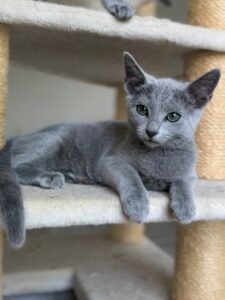
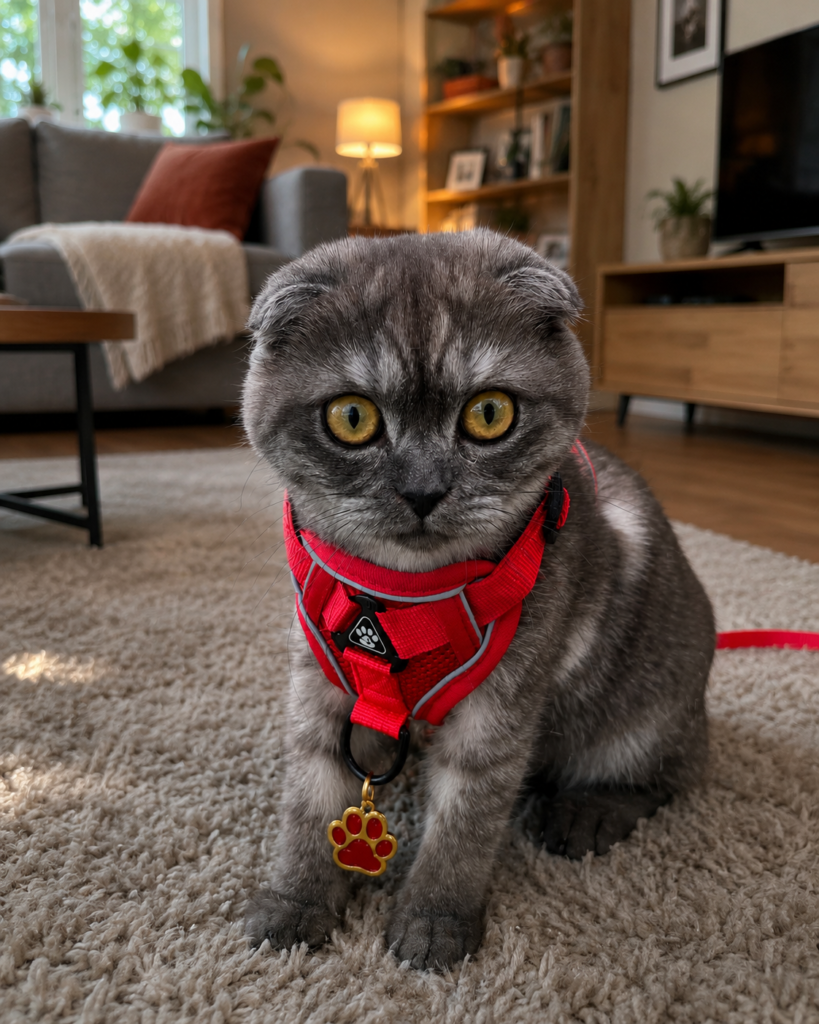
The Scottish Fold is a quiet, gentle cat with a round, owl-like face, large round eyes and ears that fold forward — and those folded ears are the first thing anyone considering the breed must understand. The fold is not just a look. It is caused by a gene that affects cartilage throughout the body, and that fact shapes how a Fold should be cared for, from its ears and its joints to the home it lives in. This guide covers the ears, the coat, feeding, comfort and the health questions to ask a breeder, honestly and without softening the welfare facts.
The breed in brief
The Scottish Fold began in Scotland in the 1960s, with a barn cat named Susie whose ears folded forward. The folded ear is caused by a naturally occurring gene mutation affecting cartilage development throughout the body, not only in the ears. Kittens are born with straight ears, which fold in the first weeks of life if they carry the gene.
The Fold is a medium-sized cat with a rounded head, large round eyes, a short nose and a dense, plush coat, in short-haired or long-haired varieties. Adults commonly weigh 2.5–6 kg. It is best known for its round face, its quiet voice, and its habit of sitting upright with its legs stretched out in front of it, a pose owners call the “Buddha sit”.
The breed is recognised by the CFA and TICA. It is not recognised by FIFe or the GCCF, which do not accept it because of the health implications of the folded-ear gene. Breeding Scottish Folds is prohibited in some countries for the same reason.
The ears: check weekly, handle gently
The folded ear needs a weekly check, and that check should be gentle. The fold can trap wax and debris, so look inside the ear and note any build-up, redness, smell or discharge. Clean the visible part of the ear only as your vet has shown you, with a product your vet recommends. Never force a folded ear open, and never clean deep inside the ear — you can injure the ear canal and you will cause the cat pain.
Watch for changes and mention them to a vet: a cat that shakes its head often, scratches at its ears, holds one ear differently, or flinches when its ears are touched. Ear infections and ear mites are possible in any cat, and a folded ear can hide the early signs, so the weekly check matters. What looks like a little extra wax can be the start of something that needs treatment.
The rest of the routine is the same as for any cat: trim the claws every couple of weeks and brush the teeth regularly, since dental disease is common in cats.
The joint condition behind the fold — read this first
The most important fact about Scottish Fold care is the condition that causes the fold. It is called osteochondrodysplasia: the cartilage throughout the cat’s body does not develop normally, which affects the ears and can also affect the joints, particularly the tail, ankles and knees. All Scottish Folds with folded ears carry this mutation, and all are affected to some degree, though the severity varies from cat to cat. Some Folds develop painful degenerative joint disease, with stiffness, lameness and reluctance to jump or climb; others show milder signs. There is no way to guarantee a Fold will be free of joint problems, and there is no cure.
That does not mean a Fold cannot live a comfortable life — it means its owner has to be the one watching for pain, because cats hide pain well. Learn what to look for, and act on it early:
- A tail that feels thick, stiff or less flexible than it used to be, or a cat that resents having its tail touched.
- Stiffness after resting, a reluctance to jump onto a favourite spot, or a cat that starts using a lower route instead of climbing.
- Swollen-looking ankles, a changed walk, or a limp that comes and goes.
- A cat that plays less, grooms less, or hides more than usual — all of these can be a cat in pain, not a cat that has simply become quiet.
If you see any of these, talk to your vet rather than waiting to see if it passes. Pain in a Fold is managed, not fixed: your vet may suggest pain relief, joint support, weight control and changes to the home, and regular check-ups so that changes in movement are caught early. Never give a cat human pain medication — many common ones are toxic to cats and can be fatal.
Responsible breeding practice reflects the same fact: breeding two folded-ear cats together is widely discouraged, because it increases the severity of the cartilage defect in the kittens. A straight-eared cat from Fold lines, sometimes called a Scottish Straight, does not carry the fold gene and is spared the condition. Anyone considering a Scottish Fold should go in with open eyes, and if the risk is not one you are comfortable carrying for the lifetime of the cat, the British Shorthair — a naturally round-faced breed with no such condition — is the safer choice.
Comfort: a low-impact, easy-going home
A Fold’s home should be built around comfort and easy movement. That starts with the places a cat reaches every day: put a step, a ramp or a sturdy low box beside the bed, the sofa and the window sill, so the cat can walk up instead of jumping down. A hard landing is the worst part of a jump for sore joints, so a soft rug or a cushioned mat where the cat lands helps too. Keep the cat’s bed, food, water and litter tray on the same floor it spends most of its time on, and choose a litter tray with low sides that is easy to step into.
Warmth matters: a warm, draught-free sleeping spot, a heated pad made for cats if your vet agrees, and a bed that supports the joints rather than a hard surface. Keep the cat lean — every extra bit of weight adds load to joints that are already compromised — and keep play low-impact: a feather wand moved slowly along the floor, a puzzle feeder, a toy rolled gently rather than thrown high. Short, regular play sessions are better than long, athletic ones, and a Fold that stops playing is telling you something, not being lazy.
The Fold’s temperament suits this kind of home. It is gentle, even-tempered and undemanding, happy to sit beside you rather than on you, following you from room to room and using its soft, quiet voice sparingly. It is usually good with respectful children and with other cats and cat-friendly dogs, and it adapts well to a calm, settled household. It is playful but not hyperactive, and it enjoys interactive play without needing constant entertainment.
The coat: weekly brushing is usually enough
The Scottish Fold’s coat is dense and plush, and for the short-haired type weekly brushing with a soft brush or a stainless steel comb is usually enough to remove loose hair and keep the coat in good condition. Shedding is heaviest in spring and autumn, when a second weekly brush helps. The long-haired type needs brushing several times a week to prevent matting, paying attention to the places that mat first — behind the ears, under the legs and under the tail.
Bathing is rarely needed. The coat’s texture sheds dirt well, and most Folds keep themselves clean. An occasional bath with a shampoo made for cats is enough if the coat gets greasy or dusty, and the cat should be dried thoroughly afterwards. Check the skin as you groom: look for redness, sores or parasites hiding under the fur, and mention anything unusual to your vet.
Feeding and weight
Scottish Folds are moderate eaters, and they can gain weight if fed too freely — particularly indoor cats, which are less active than outdoor ones. Feed a good-quality complete cat food in measured amounts, follow the feeding guide for the cat’s weight and age, and keep treats small. Fresh water should always be available.
Weigh your cat regularly and ask your vet whether its weight is right — you should be able to feel the ribs easily under a thin layer of fat. For a Fold, weight control is not cosmetic: it is one of the few things an owner can do every day that directly reduces the strain on its joints. A Fold that is overweight loses mobility faster and feels its joint disease sooner.
Folds can be fussy about food, and some are sensitive to sudden changes — change foods gradually over a week or so, and see a vet if a cat refuses food for more than a day.
Health and screening to ask about
For the Scottish Fold, ask about joints and cartilage first: how do the parents move, have they shown stiffness or lameness, and what veterinary assessment have they had? Ask also about polycystic kidney disease (PKD), for which a DNA test exists, and about hypertrophic cardiomyopathy (HCM), the most common heart disease in cats, diagnosed by echocardiogram performed by a veterinary cardiologist.
No screening programme makes any cat “risk-free” — it reduces risk and shows the breeder is breeding carefully. Always ask to see the actual results for the actual parents (our guide to choosing a responsible breeder lists the questions to ask). A vet who sees the cat at least once a year — more often as it ages, and promptly if its movement changes — is part of the care routine, not an emergency measure.
Is a Scottish Fold right for you?
- Choose a Scottish Fold if you want a quiet, gentle, owl-faced companion that will sit beside you and follow you around — and you accept the joint-health risk that comes with the folded ear, and are prepared to watch your cat’s movement, keep it lean, adapt its home, and work with a vet over its lifetime.
- Think again if you want a cat you can be sure will stay athletic and pain-free, you are not comfortable with a lifetime of joint monitoring, or you want a breed with no known cartilage condition attached to its defining feature — the British Shorthair, or a straight-eared Scottish Straight, gives you the same round-faced charm without it.
Still deciding? Read the full breed guide for the Scottish Fold — and if you are considering a kitten, start with an enquiry and an honest conversation about your household, how much time you can give every day, and whether you are comfortable with the joint-health facts above. The right match matters more than the fastest one. If you have general questions about bringing a kitten home, our kitten FAQ covers the basics.