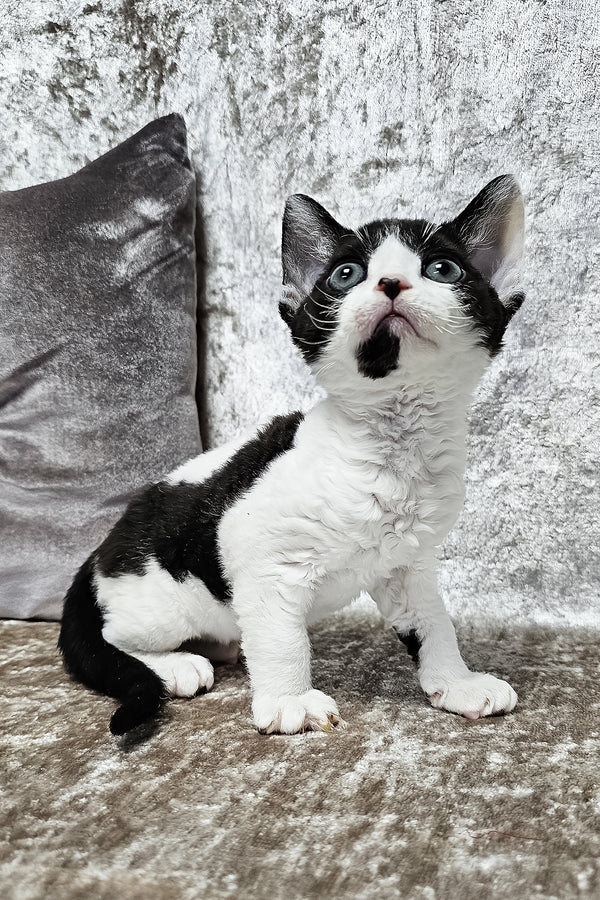
The Devon Rex is a small, elfin cat with huge ears, a curly coat and an enormous personality. It is one of the most people-oriented breeds there is: a Devon Rex wants to be on your lap, on your shoulder, under the blanket with you — wherever you are, it wants to be there too.
The breed in brief
The Devon Rex appeared in Devon, England, in the 1960s, when a curly-coated kitten was found in a litter of farm cats. The breed is small and fine-boned, with a slender body, long legs, a wedge-shaped head, very large ears set low on the head, large oval eyes and a short, wavy or curly coat. Adults commonly weigh 2.5–4.5 kg, and the whiskers are often curly or crinkled too.
The breed is recognised by all the major registries, including TICA, the CFA, the GCCF and FIFe, which consistently describe the same temperament: intelligent, active, affectionate and deeply people-oriented. A Devon Rex is not a cat that keeps its distance — it is a cat that wants to be involved in everything you do.
Personality: a devoted, mischievous companion
The Devon Rex is often described as a pixie, an elf or a monkey in a cat suit, and the personality lives up to the nicknames. It is curious, clever and playful, and it will investigate every cupboard, perch on the highest shelf and learn to open doors and drawers. Many Devon Rexes learn to fetch, to walk on a lead and to come when called.
Above all, the Devon Rex is social. It bonds closely with its people, follows them from room to room, sleeps on them or beside them, and can become lonely if left alone for long hours every day. This is a breed that does best in a home where someone is around for much of the day, or where there is another friendly cat or a cat-friendly dog for company.
Devon Rexes are usually good with respectful children and with other pets, provided introductions are gradual. They have a soft, chirping voice, and they use it to talk to their people.
The coat: curly, delicate and different
The Devon Rex coat is unlike almost any other cat’s. It is short, soft and wavy or curly, with very little guard hair — the stiff outer hairs that give most coats their structure. That makes the coat delicate: it breaks easily, it can thin with age or stress, and it needs a gentle hand.
Brush lightly and infrequently — once a week with a soft brush or simply with your hand is usually enough, and over-brushing will damage the curls and break the hairs. Some Devon Rexes have very sparse coats, especially on the belly, and that is normal for the breed. Never use a stiff brush or a de-shedding tool on a Devon Rex.
Because the coat is so thin, a Devon Rex sheds very little, and many people find less loose hair around the house. But that does not make the breed hypoallergenic: all cats produce the Fel d 1 protein that triggers most cat allergies, and no breed is truly hypoallergenic. Anyone with allergies should spend time with the breed before committing, and should talk to their doctor.
Bathing: a regular part of the routine
One thing that surprises new Devon Rex owners is that the breed often needs regular bathing. With so little coat to absorb skin oils, a Devon Rex’s skin can become greasy, and the oils can build up in the folds of the skin — especially around the neck, the ears and the paws. A bath every few weeks with a shampoo made for cats keeps the skin clean and comfortable.
Start bathing young, keep the water warm but not hot, and be gentle — many Devon Rexes tolerate baths well if the experience is calm and they are dried thoroughly afterwards. Rinse completely, since shampoo residue irritates the skin, and dry the cat in a warm room: a thin-coated cat chills easily when wet.
The paw pads and the skin between the toes can also collect oil, so check them during the bath and clean them gently. If the skin ever looks red, flaky or sore, or the cat scratches a lot, see a vet rather than bathing more often — over-bathing can dry the skin out.
Ears: large, and they need attention
The Devon Rex’s huge ears are part of its charm and part of its care routine. Ear wax builds up more quickly in large ears, and the ears should be checked weekly. Clean them gently, only as your vet has shown you, using a vet-recommended ear cleaner and a soft cloth or cotton ball — never push anything deep into the ear canal, and never use cotton buds inside the ear.
Healthy ears are clean and pink with a small amount of light wax. Dark, crumbly debris, a bad smell, redness or a cat that shakes its head or scratches its ears persistently all need a vet visit: ear mites and ear infections are both treatable, but they need proper diagnosis.
Warmth: a cat that feels the cold
With its thin coat, the Devon Rex feels the cold more than most cats. It seeks warmth constantly — a sunny windowsill, a warm lap, a heated bed, a spot next to a radiator — and in winter it will often burrow under blankets or into your clothes. That is normal behaviour, not fussiness.
Give a Devon Rex warm places to sleep: a covered bed, a blanket, a spot in the sun. In cold weather, a sweater made for cats can help, although not every cat tolerates one. Never leave a Devon Rex in a cold room for long, and keep it indoors in winter. Sunbathing is a favourite pastime, but the thin coat also means the skin can burn — a Devon Rex should not spend long in strong direct sun, especially a pale-coated one.
Feeding and weight
Devon Rexes are active cats with a fast metabolism, and they tend to eat well. Feed a good-quality complete cat food in measured amounts, follow the feeding guide for the cat’s weight and age, and keep treats small. Fresh water should always be available.
Because the breed is so active, a Devon Rex rarely becomes overweight — but weigh your cat regularly anyway, and ask your vet whether its weight is right. You should be able to feel the ribs easily under a thin layer of fat.
Play, enrichment and indoor life
The Devon Rex is a strictly indoor cat — its thin coat, its trusting nature and its curiosity make free roaming a poor idea. Indoors, it needs a great deal to do. It is one of the most intelligent and energetic breeds, and a bored Devon Rex will invent its own entertainment, usually at the expense of your belongings.
Provide tall cat trees, shelves and perches for climbing, puzzle feeders and interactive toys for the mind, and a scratching post for the claws. Short, frequent play sessions — a feather wand, a rolling ball, a puzzle feeder, a game of fetch — suit the breed better than one long session. Many Devon Rexes enjoy learning tricks, and training is good mental exercise.
A window with a view is a favourite, and secured outdoor access such as a cat-proofed balcony, garden or catio gives a Devon Rex fresh air and new smells without the risks of roaming.
Health and screening to ask about
Responsible breeders screen their breeding cats for the hereditary conditions relevant to the breed, and the questions to ask differ by breed.
For the Devon Rex, the most important condition to ask about is Devon Rex myopathy — also called hereditary myopathy or spasticity — a muscle weakness that can affect kittens. A DNA test exists for it, and responsible breeders test their breeding cats. Ask also about patellar luxation (a kneecap that slips out of place) and about hypertrophic cardiomyopathy (HCM), the most common heart disease in cats, which can occur in the breed.
No screening programme makes any cat “risk-free” — it reduces risk and shows the breeder is breeding carefully. Always ask to see the actual results for the actual parents (our guide to choosing a responsible breeder lists the questions to ask).
A vet who sees the cat at least once a year — more often as it ages — is part of the care routine, not an emergency measure.
Is a Devon Rex right for you?
- Choose a Devon Rex if you want a clever, affectionate, endlessly entertaining companion, you are home for much of the day, and you enjoy a cat that is always involved in what you are doing.
- Think again if you are away for long hours every day, you want a quiet, independent cat, or you dislike a cat that follows you everywhere — a Devon Rex that is left alone too much can become lonely and unhappy.
Still deciding? Read the full breed guide for the Devon Rex — and if you are considering a kitten, start with an enquiry and an honest conversation about your household, your working hours and how much company you can give every day. The right match matters more than the fastest one. If you have general questions about bringing a kitten home, our kitten FAQ covers the basics.