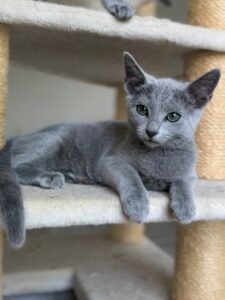
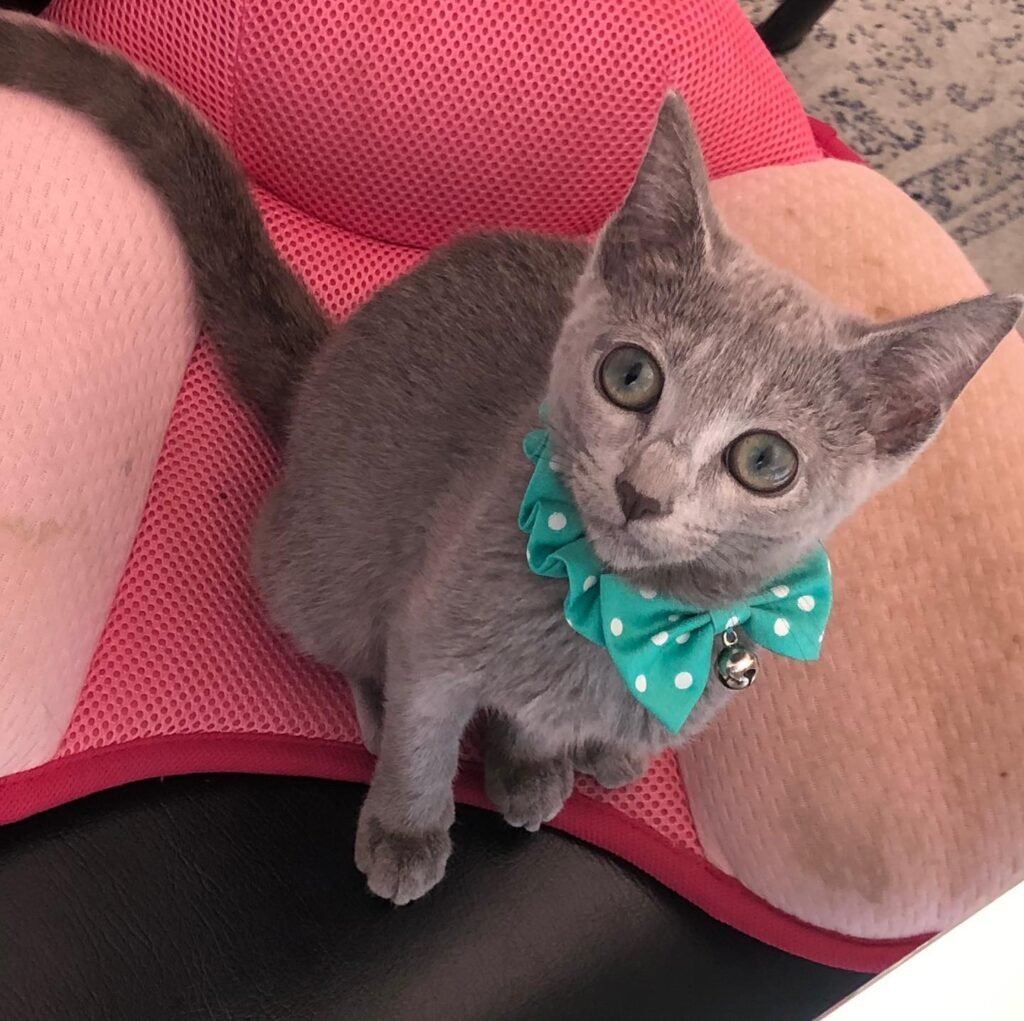
The Russian Blue is a quiet, elegant cat with a dense silver-blue coat, vivid green eyes and a gentle, reserved nature. It is a breed that bonds deeply with its own people while staying cautious around strangers, and it suits a calm household where routine is respected and company is steady. This guide covers the coat, the personality, feeding, play and the health questions to ask a breeder — everything a future owner needs to care for one well.
The breed in brief
The Russian Blue is a medium-sized cat with a fine-boned but muscular build, a wedge-shaped head, large pointed ears set wide apart, and striking green eyes. Its defining feature is the coat: short, dense and double, in a blue-grey shade tipped with silver, which gives the cat its characteristic shimmering look. The coat stands out from the body rather than lying flat, and it feels plush and soft to the touch.
The breed’s origins lie in northern Russia, and it has been recognised by the major registries — FIFe, TICA, the CFA and the GCCF — for many decades. All of them describe the same temperament: gentle, quiet, loyal and a little shy. Adults commonly weigh 3.5–5.5 kg, with males slightly heavier than females. Russian Blues mature slowly and often keep a kittenish playfulness well into adulthood.
Personality: loyal, gentle and reserved
The Russian Blue is a cat of one household. It forms a close bond with its own people, follows them around the house, greets them at the door and often chooses one person as its favourite. With its family it is affectionate and playful; with strangers it is cautious and will usually retreat to a safe spot until it decides the visitor is harmless. That shyness is not fearfulness — it is the breed’s nature — but it does mean a Russian Blue should never be forced into the middle of a noisy gathering.
Russian Blues are quiet cats. They have a soft, gentle voice and use it sparingly, which makes them a good fit for flats and for homes where peace matters. They are also notably sensitive to routine: they like their meals at the same time, their favourite spot undisturbed, and their home calm. Sudden changes — a house move, building work, a new pet arriving without preparation — can unsettle them more than they would a bolder breed, so changes should be introduced gradually.
Despite the reserve, the Russian Blue is not a distant cat. It enjoys play, it enjoys company, and it enjoys being part of family life — on its own terms. It is often described as intelligent and even a little dog-like in its loyalty, and many Russian Blues learn to fetch, to open doors and to follow a daily routine with clockwork precision. Children who are calm and respectful usually get on well with a Russian Blue; very young or boisterous children may find the cat simply walks away.
The coat: dense, plush and easy to keep
The Russian Blue’s double coat is one of the easiest pedigree coats to maintain. The dense undercoat and short guard hairs need only a weekly brush with a soft brush or a stainless steel comb to remove loose hair and keep the coat in good condition. Shedding is moderate and heaviest in spring and autumn, when a second weekly brush helps keep loose hair off the furniture.
Bathing is rarely needed. The coat’s texture sheds dirt well, and most Russian Blues keep themselves clean. An occasional bath with a shampoo made for cats is enough if the coat gets greasy or dusty, and the cat should be dried thoroughly afterwards — a dense double coat takes a while to dry.
One claim to be careful about: the Russian Blue is sometimes described as a good choice for people with allergies, because it is said to produce less of the Fel d 1 protein that triggers most cat allergies. That is not a promise. All cats produce Fel d 1, levels vary from cat to cat, and no breed is truly hypoallergenic. Anyone with allergies should spend time with the breed before committing, and should talk to their doctor — a coat that sheds less is not the same as a cat that will not trigger a reaction.
The rest of the routine is the same as for any cat: trim the claws every couple of weeks, check the ears weekly and clean them gently only as your vet has shown you, and brush the teeth regularly, since dental disease is common in cats.
Feeding and weight
Russian Blues are moderate eaters with a healthy appetite, and they can gain weight if fed too freely — particularly indoor cats, which are less active than outdoor ones. Feed a good-quality complete cat food in measured amounts, follow the feeding guide for the cat’s weight and age, and keep treats small. Fresh water should always be available, and many Russian Blues prefer a water fountain or a wide bowl, since their whiskers are sensitive to narrow dishes.
Weigh your cat regularly and ask your vet whether its weight is right — you should be able to feel the ribs easily under a thin layer of fat. A Russian Blue that is overweight loses the fine-boned elegance of the breed and puts extra strain on its joints.
Russian Blues can be fussy about food, and some are sensitive to sudden changes — change foods gradually over a week or so, and see a vet if a cat refuses food for more than a day.
Play, enrichment and indoor life
The Russian Blue is an active, intelligent cat that needs daily play, but it plays on its own terms: short, focused sessions rather than long, boisterous ones. Interactive toys, puzzle feeders, a scratching post and a tall cat tree for climbing and surveying are all good. Russian Blues enjoy games that engage their intelligence — a puzzle feeder, a toy hidden under a blanket, a feather wand moved slowly rather than waved frantically — and many learn to play fetch with a small ball or a crumpled piece of paper.
The breed is well suited to indoor life. Its cautious nature and its striking appearance make free roaming a poor idea, and indoor living with secured outdoor access — a cat-proofed balcony, garden or catio — gives a Russian Blue fresh air and new smells without the risks of roaming. A window with a view is a favourite spot: Russian Blues are keen watchers and will spend long stretches observing the world outside.
Because the breed is sensitive to change, its environment matters. A quiet corner with a comfortable bed, a hiding place for when visitors arrive, and a predictable daily routine all help a Russian Blue feel secure. A home that is calm and consistent will get the best out of this breed.
Health and screening to ask about
The Russian Blue is generally a healthy, long-lived breed, with many cats living into their mid-to-late teens. Responsible breeders still screen their breeding cats, and the questions to ask are the same as for any breed: ask about the parents’ general health and veterinary care, and about the health screening the breeder carries out.
There is no single hereditary condition that defines the breed, but heart disease — hypertrophic cardiomyopathy (HCM), the most common heart disease in cats — can occur, and responsible breeders monitor for it. Ask also about kidney health and dental health, since both matter as the cat ages. No screening programme makes any cat “risk-free” — it reduces risk and shows the breeder is breeding carefully. Always ask to see the actual results for the actual parents (our guide to choosing a responsible breeder lists the questions to ask).
A vet who sees the cat at least once a year — more often as it ages — is part of the care routine, not an emergency measure. Regular check-ups catch weight gain, dental problems and early signs of illness while they are still easy to manage.
Is a Russian Blue right for you?
- Choose a Russian Blue if you want a quiet, loyal, gentle companion, you enjoy a calm and predictable household, and you can give the cat a steady routine and a safe, quiet corner of its own.
- Think again if your home is loud and constantly changing, you want a bold cat that greets every visitor at the door, or you are away for long hours every day — a Russian Blue that is left alone too much can become withdrawn.
Still deciding? Read the full breed guide for the Russian Blue — and if you are considering a kitten, start with an enquiry and an honest conversation about your household, your working hours and how much company you can give every day. The right match matters more than the fastest one. If you have general questions about bringing a kitten home, our kitten FAQ covers the basics.