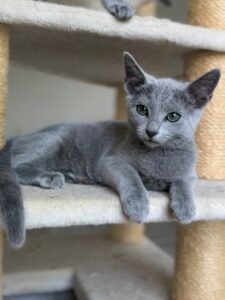

Two grey-coated breeds, two very different personalities. The British Shorthair and the Russian Blue are often compared because they look alike at first glance: both are plush, blue-grey cats with round faces and a reputation for calm. Spend time with them, though, and the differences soon become clear. One is an easygoing, independent companion who is happy to share your home on its own terms; the other is a quiet, devoted shadow who bonds deeply with its people and notices every change in routine.
This comparison covers temperament, care, health and everyday life, drawing on breed standards from FIFe, TICA, the CFA and the GCCF, and on general veterinary guidance. Neither breed is universally better: the right choice depends on your household, your routine and how much interaction you want from a cat.
At a glance
The two breeds share a grey-blue coat and a calm reputation, but they were developed in very different ways. The British Shorthair is one of the oldest recognised pedigree breeds, a sturdy, cobby cat bred for companionship. The Russian Blue is a finer, more elegant cat, known for a short, dense double coat with silver tipping and vivid green eyes.
- British Shorthair: stocky and muscular, broad chest, round face, dense plush coat, copper or gold eyes, typically 4–8 kg.
- Russian Blue: slender and graceful, wedge-shaped head, short dense coat with a silver sheen, green eyes, typically 3.5–5.5 kg.
- Both: quiet voices, moderate activity levels, content indoors, and long-lived.
- British Shorthair: famously independent and tolerant of being left alone during the day.
- Russian Blue: strongly bonded to its family and more sensitive to change and to strangers.
If you are exploring either breed in more detail, you can read our breed guides to British Shorthair kittens and Russian Blue kittens.
Temperament: the easygoing companion and the loyal shadow
The British Shorthair is often described as one of the calmest pedigree breeds. It is affectionate without being demanding: it will follow you from room to room, settle nearby and accept a fuss on its own terms, but it rarely insists on being picked up or carried. Many British Shorthairs dislike being held for long and prefer to sit beside you rather than on you. That independence makes the breed a good fit for people who are out during the day, provided the cat has company, play and a predictable routine when they return.
The Russian Blue is quieter and more reserved, but no less affectionate. It usually chooses one or two people and bonds to them deeply, greeting them at the door, following them around the house and settling close by in the evening. With strangers it is often shy at first, sometimes disappearing to a safe spot until it decides the visitor is acceptable. For an owner who wants a gentle, loyal companion and a calm, predictable home, that devotion is the breed’s greatest appeal. For a busy, noisy household with a constant flow of guests, it can be a drawback.
Children, visitors and other pets
With children, the British Shorthair’s patience is a real strength. It tolerates the noise and bustle of family life well, and it is more likely to walk away from rough handling than to react. Children should still be taught to handle any cat gently and to let it leave when it wants to, and an adult should always supervise young children with a cat.
The Russian Blue can be a wonderful family cat too, but it suits calm, older children best. A young child who chases or grabs may frighten it, and a frightened Russian Blue will hide rather than engage. In a quiet household where children understand that the cat comes to them, the breed often becomes a devoted companion.
With other pets, both breeds generally adapt well when introductions are gradual. British Shorthairs are usually relaxed about sharing a home with another cat or a calm dog, while Russian Blues prefer a slow introduction and a quiet corner of their own. As with any breed, the individual cat’s early socialisation matters at least as much as the breed label.
Care: coats, food and activity
The two coats look similar in colour but need slightly different care. The British Shorthair’s coat is dense, crisp and plush, with a thick undercoat. A weekly brush is usually enough to keep it in good condition and to reduce loose hair, though it sheds more heavily in spring and autumn, when a second weekly session helps. The Russian Blue’s coat is short, dense and fine, with a double layer that stands out from the body and gives the silver tipping its shine. It also benefits from a weekly brush, and because it sheds less for much of the year, grooming is a quick job.
Both breeds are indoor cats by nature, and both can put on weight if food and activity are not watched. The British Shorthair is the more obvious risk: it is a heavily built cat with a moderate appetite and a relaxed attitude to exercise, so portion control matters. Feed a complete food suited to age and body condition, measure meals rather than leaving food out all day, and weigh the cat regularly. The Russian Blue is usually leaner and more active, but the same principles apply: measured meals, play every day and a body condition you can check by feeling the ribs easily under a thin layer of fat.
Neither breed needs a large garden or a demanding exercise routine. A scratching post, a couple of perches or shelves, a wand toy and a short daily play session are usually enough, and both breeds enjoy puzzle feeders that make them work a little for their food.
Health and lifespan
Both breeds are long-lived, and the Russian Blue is one of the longest-lived pedigree breeds, often living into its late teens and sometimes beyond. The British Shorthair typically lives from 12 to 17 years. Longevity depends on genetics, weight, diet and veterinary care, and no breeder can guarantee an individual cat’s lifespan.
At breed level, the health picture differs. The Russian Blue is generally regarded as a healthy breed with few breed-specific inherited problems, although it still needs vaccinations, parasite control and routine veterinary checks. The British Shorthair’s main recognised concern is hypertrophic cardiomyopathy, a heart condition that affects a number of pedigree breeds; responsible breeding programmes screen for it, and prospective owners should ask what screening the parents have had. British Shorthairs can also be prone to polycystic kidney disease, though less commonly than some other breeds, and to obesity, which itself increases the risk of diabetes and joint problems.
What matters for any buyer is the same in both breeds: ask for the parents’ health screening results, a written veterinary record for the kitten, and a clear explanation of what is covered by any health commitment before you reserve.
Which breed suits your home?
Think about your household honestly, and the answer usually follows:
- Choose a British Shorthair if you want a calm, tolerant cat that is happy with its own company during the day, copes well with visitors and family bustle, and does not demand to be carried or constantly entertained.
- Choose a Russian Blue if you want a quiet, loyal companion that bonds closely with its people, and your home is calm, predictable and not too full of strangers.
- Either breed suits a quiet apartment, a home with older children, or an owner who wants a cat that is affectionate but not demanding.
- Think again about a Russian Blue if your home is noisy, your hours are irregular, or visitors come and go all day.
- Think again about a British Shorthair if you want a cat that loves being picked up and carried, or one that will follow you everywhere. Most British Shorthairs prefer to be near you, not on you.
Questions worth asking any breeder
Whichever breed you lean towards, the same checks apply. Ask whether the kittens are raised in the home and handled daily, at what age they go to their new homes, which vaccinations and identification the kitten will have, and what written records come with it. Ask for the parents’ health screening results and for a pedigree or registration document if the kitten is described as a pedigree of a named breed. Our guide to choosing a responsible cat breeder sets out twelve questions worth asking before you reserve a kitten, and they are a good checklist for either breed.
The bottom line
The British Shorthair and the Russian Blue share a colour and a calm reputation, but they suit different homes. The British Shorthair is the steadier, more independent of the two: undemanding, tolerant and happy in a busy family. The Russian Blue is the more devoted: quieter, shyer with strangers, and happiest in a calm home with people it knows and trusts. Choose the cat whose temperament matches the life you actually live.