The Norwegian Forest cat is a big, weatherproof cat built for a Scandinavian winter — a thick double coat, a sturdy frame, tufted ears and paws, and a climber’s confidence. It is also one of the most easy-going pedigree breeds, happy to sit near you without demanding constant attention. The care trade-off is honest and simple: the coat needs real grooming, especially when the winter undercoat comes out in spring, and a cat built to climb needs height and somewhere safe to explore. This guide covers the coat, the grooming routine, climbing and outdoor time, and the home this breed needs.
The breed in brief
The Norwegian Forest cat — the Norsk skogkatt — is Norway’s native longhaired breed, shaped by centuries of life in cold forests before breeders formalised it in the twentieth century. It is recognised by FIFe, TICA and the CFA. It is a large, slow-maturing cat: males can reach around 7–9 kg, females are somewhat smaller, and the cat may not reach its full size and coat until three or four years old. The build is long, solid and muscular, with a triangular head, almond eyes and a straight profile.
The coat is the breed’s signature. It is a double coat: long, smooth, water-repellent guard hairs over a dense, woolly undercoat, with a full ruff around the neck, breeches on the hind legs and tufts between the toes. In winter it is at its thickest; in summer much of the undercoat is shed and the coat lies lighter and shorter. The temperament is affable, laid-back and confident — a cat that enjoys company, tolerates children and other pets well, and is not usually demanding or noisy. It is a hunter and a climber by nature, and it is more independent than many longhaired breeds.
The coat: grooming the double layer
The Norwegian Forest cat sheds moderately through the year, then sheds heavily twice a year when the seasons change — most of all in spring, when the thick winter undercoat is dropped in what breeders call the coat blow, and more lightly in autumn. Outside the coat blow, a weekly comb-through is usually enough; during the spring blow, daily brushing is the safer routine, and it is the one time of year when skipping grooming shows up quickly as tangles.
The tool matters more than the frequency. A slicker brush only skims the surface of a coat this thick. Use a wide-toothed steel comb or an undercoat rake with pins long enough to reach through the guard hairs into the undercoat — that is where mats start. Work through the coat in sections, gently and without pulling, and pay particular attention to the mat-prone areas: the breeches on the hind legs, the armpits and behind the ears. If you find a mat, work it apart with your fingers first; never cut a mat out with household scissors, because a cat’s skin is very thin and folds easily into a mat.
Baths are rarely needed — two to four times a year at most, and many Norwegian Forest cats go longer without one. The coat is water-repellent by design, so when a bath is needed it usually takes a degreasing shampoo made for cats and a thorough rinse to get the coat properly wet. A dull, greasy or suddenly thinning coat is worth a vet visit: the coat’s condition reflects diet and general health.
The rest of the routine is the same as for any cat, but the thick coat hides things: use grooming time to check the skin underneath for flakes, lumps, redness or parasites. Trim the claws every two to three weeks, check the ears weekly and clean them only if there is visible debris, and brush the teeth several times a week with cat-safe toothpaste.
Climbing: a cat that needs height
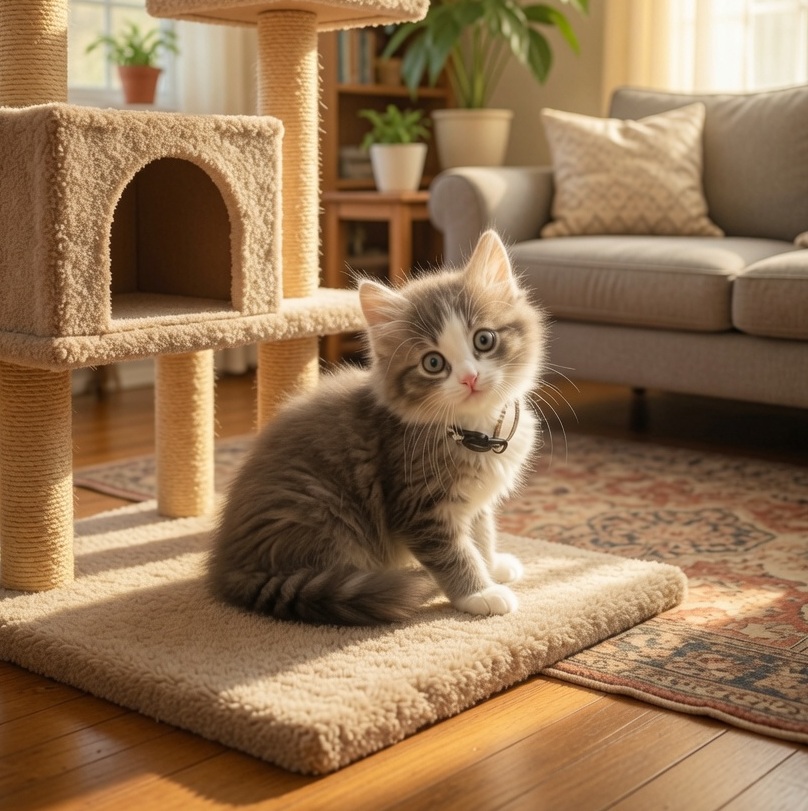
Norwegian Forest cats are natural climbers — strong, agile and fond of high places — and a home without vertical space will bore one quickly. A tall, sturdy cat tree is the starting point, not a luxury: this is a large, heavy cat, so the tree must be stable enough not to wobble under it. Wall-mounted shelves or a climbing route that lets the cat move from floor to ceiling height give it the territory it wants, and a window perch gives it something to watch from up high.
Climbing is also how this breed plays. Interactive wand toys worked along shelves and trees, puzzle feeders and toys that move like prey suit it better than a ball rolled across the floor. It is a moderately active cat — not hyperactive like a Bengal, but not a cat that sleeps all day either. A few play sessions a day, plus the freedom to climb and explore, keep it content. A bored Norwegian Forest cat will find its own high places — the top of the wardrobe, the kitchen cupboards — so give it approved ones first.
Safe outdoor time
This breed was built to roam outdoors, and supervised outdoor time suits it well — but “outdoors” needs to be safe. A cat-proof garden, a secure catio, or harness walks introduced slowly with a properly fitted harness are the sensible options. Free roaming is not recommended: roads, other animals, disease and the risk of the cat simply wandering off are real, and a pedigree cat is a target for theft in some areas.
Indoor-only living works well for this breed too, provided the home offers enough vertical space, play and window views to make up for the outdoors. Whichever you choose, the key is consistency: a cat that has tasted free roaming will demand the door, so decide the arrangement early and stick to it. Our kitten FAQ covers the basics of bringing a kitten home safely, including the first weeks indoors.
Feeding and weight
A Norwegian Forest cat is a big, muscular cat and should look like one — solid and well-proportioned, with ribs that are easy to feel under a thin layer of fat. Feed a good-quality complete cat food in measured amounts, following the feeding guide for the cat’s weight and age, and keep treats small and counted inside the daily allowance. Because the breed is slow to mature, a young cat’s needs change over several years — ask your vet about feeding as it grows.
Fresh water should always be available. Many cats of this breed enjoy drinking from a wide bowl or a fountain, and a water fountain is worth trying if your cat seems to drink little. Weigh your cat regularly: the thick coat hides weight changes, so the scales and your hands on its ribs are more reliable than your eyes.
Health and screening to ask about
Responsible breeders screen breeding cats for the hereditary conditions relevant to the breed, and the questions to ask differ by breed.
For the Norwegian Forest cat, the conditions most often discussed are hypertrophic cardiomyopathy (HCM), the most common heart disease in cats, diagnosed by echocardiogram performed by a veterinary cardiologist; glycogen storage disease type IV (GSD IV), an inherited condition for which a DNA test exists; and hip dysplasia, which is reported in the breed. Ask also about patellar luxation. No screening programme makes any cat “risk-free” — it reduces risk and shows the breeder is breeding carefully. Always ask to see the actual results for the actual parents (our guide to choosing a responsible breeder lists the questions to ask). A vet who sees the cat at least once a year — more often as it ages — is part of the care routine, not an emergency measure. Norwegian Forest cats commonly live 12–16 years, and some live longer.
Is a Norwegian Forest cat right for you?
- Choose a Norwegian Forest cat if you want a calm, confident companion, you can give it tall climbing furniture and safe outdoor time or a well-enriched indoor home, and someone at home will keep up with grooming — especially in spring.
- Think again if nobody will brush a thick double coat through the spring coat blow, you have no room for tall climbing furniture, or you want a small, low-shedding cat.
Still deciding? Read the full breed guide for the Norwegian Forest cat — and if you are considering a kitten, start with an enquiry and an honest conversation about your household, your space and how much grooming time you can give every week. The right match matters more than the fastest one. If you have general questions about bringing a kitten home, our kitten FAQ covers the basics.