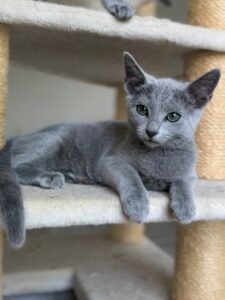

The Ragdoll is one of the gentlest breeds in the cat world: a large, soft, blue-eyed cat that follows its people around the house, flops down beside them, and is famously relaxed about being held. The breed’s name comes from a tendency to relax and go limp in the arms, like a rag doll, and that easy-going nature is the reason so many families choose it. But a Ragdoll is not low-maintenance in every sense: it has a long, silky coat to care for, it needs company, and it is a strictly indoor breed. This guide covers the coat, the temperament, the indoor life and the daily routine, plus feeding and the health screening to ask a breeder about.
The breed in brief
The Ragdoll is a relatively young breed, developed in California in the 1960s. It is one of the largest domestic breeds: a long, muscular, substantial cat with a broad head, a medium-length muzzle, large oval blue eyes and a semi-long, silky coat in the colourpoint pattern — a paler body with darker colour on the ears, face, legs and tail. Males commonly weigh 6–9 kg and females around 4.5–6 kg. Ragdolls mature slowly, taking up to three or four years to reach their full size and colour.
The breed is recognised by all the major registries, including TICA, the CFA, the GCCF and FIFe, which consistently describe the same temperament: gentle, docile, affectionate and people-oriented. That is the Ragdoll’s defining feature, and it shapes everything else about living with one.
Temperament: gentle, social and relaxed
The Ragdoll is famously placid. It is a cat that seeks out its people, follows them from room to room, greets them at the door and settles down wherever they are — usually on a lap, or as close to one as it can get. Ragdolls are often described as puppy-like or dog-like in their loyalty: this is a breed that wants to be involved in family life rather than watching it from a distance.
Ragdolls are generally quiet cats. They have a soft, gentle voice and use it sparingly, which makes them a good fit for households that value peace — flats, homes with small children who nap, or anyone who works from home. They are also famously tolerant: Ragdolls are usually patient with respectful children and accepting of other cats and cat-friendly dogs, provided introductions are gradual. That tolerance is a strength, not an invitation to test it — a Ragdoll that is handled roughly will simply withdraw rather than fight back, and a cat that cannot escape unwanted attention is a stressed cat, whatever the breed.
The Ragdoll’s social nature has one important consequence: it needs company. A Ragdoll left alone for long hours every day can become lonely and bored, and may overeat, over-groom or become withdrawn. This is a breed that does best in a home where someone is around for much of the day, or where there is another friendly cat for company.
Individual cats vary, of course, but the broad pattern holds: the Ragdoll is gentle, social and relaxed, and it needs an owner who enjoys a cat that wants to be close.
The coat: silky, but it still needs work
The Ragdoll’s coat is semi-long, soft and silky, with very little undercoat. That is good news in one way: the coat is less prone to matting than the dense double coat of a breed like the Persian, and a weekly brush is usually enough to keep it in good condition. But weekly is a minimum, not an aspiration — left for a fortnight or more, even a silky coat will tangle, especially behind the ears, under the legs and around the collar area.
The routine is simple: a stainless steel comb or a soft slicker brush, worked gently through the whole coat once or twice a week, paying attention to the places that tangle first. Most Ragdolls enjoy being groomed and will settle into the routine if it is started young and kept calm. Shedding is heaviest in spring and autumn, when the coat needs extra attention, and a quick brush during those weeks keeps loose hair off the furniture.
Bathing is rarely needed — the coat’s texture means it stays cleaner than a denser coat — but an occasional bath with a shampoo made for cats can help if the coat gets greasy. Rinse thoroughly and dry the cat completely; a damp long-coated cat left to dry on its own will mat.
The rest of the routine is the same as for any cat: trim the claws every couple of weeks, check the ears weekly and clean them gently only as your vet has shown you, and brush the teeth regularly — dental disease is common in cats, and Ragdolls are no exception.
Feeding and weight
Ragdolls are large cats with a slow metabolism, and they are not a particularly active breed — that combination means they can gain weight easily if fed too much. Feed a good-quality complete cat food in measured amounts, follow the feeding guide for the cat’s weight and age, and keep treats small. Fresh water should always be available. Weigh your cat regularly and ask your vet whether its weight is right — you should be able to feel the ribs easily under a thin layer of fat.
Obesity makes everything harder for a Ragdoll: joints, grooming and general health. Because the breed is so relaxed, it will not always exercise itself — play is something you need to initiate. Short, regular play sessions keep a Ragdoll at a healthy weight and give it the stimulation it needs.
Ragdolls can be fussy eaters, and some are sensitive to sudden food changes — change foods gradually over a week or so, and see a vet if a cat refuses food for more than a day.
Play, enrichment and indoor life
The Ragdoll is an indoor cat — this is not a suggestion but a practical fact of the breed. Its trusting, docile temperament, its lack of street sense and its striking appearance make it poorly suited to free roaming. Ragdolls are known for being slow to react to danger and for approaching strangers without fear, which makes the outdoors a risky place for them. Indoor living, with secured outdoor access such as a cat-proofed balcony, garden or catio, gives a Ragdoll fresh air and new smells without the risks of roaming.
Indoors, a Ragdoll needs things to do. It is a quieter, less athletic breed than a Bengal or a Siamese, but it still needs daily play: interactive toys, puzzle feeders, a scratching post, a tall cat tree for climbing and surveying, and a window with a view. Ragdolls often enjoy gentle games — a feather wand, a rolling ball, a puzzle feeder — and many learn to play fetch. Keep sessions short and regular rather than long and occasional, and remember that a Ragdoll would often rather play with you than play alone.
Health and screening to ask about
Responsible breeders screen breeding cats for the hereditary conditions relevant to the breed, and the questions to ask differ by breed.
For the Ragdoll, the most important condition to ask about is hypertrophic cardiomyopathy (HCM), the most common heart disease in cats. A DNA test exists for the HCM mutation found in Ragdolls, and responsible breeders test their breeding cats; HCM is also diagnosed by echocardiogram performed by a veterinary cardiologist. Ask also about the parents’ general health and veterinary care, and about kidney health, since Ragdolls can be prone to kidney problems including polycystic kidney disease (PKD), although this is less common in the breed than in some others.
No screening programme makes any cat “risk-free” — it reduces risk and shows the breeder is breeding carefully. Always ask to see the actual results for the actual parents (our guide to choosing a responsible breeder lists the questions to ask).
Ragdolls can also be prone to urinary tract issues and, like all cats, to dental disease, so regular veterinary check-ups matter. A vet who sees the cat at least once a year — more often as it ages — is part of the care routine, not an emergency measure.
Living with families and other pets
The Ragdoll is one of the best breeds for families with children, provided the children are taught to handle the cat gently. Its patience and tolerance are real, but they have limits — a Ragdoll that is picked up roughly, chased or teased will retreat and lose trust. Teach children to let the cat come to them, to support its body when holding it, and to leave it alone when it walks away. Ragdolls usually live well with other cats and cat-friendly dogs too, with gradual introductions.
Is a Ragdoll right for you?
- Choose a Ragdoll if you want a gentle, affectionate, quiet companion that will follow you around the house, you enjoy a weekly grooming routine, and someone is home for much of the day to give it the company it needs.
- Think again if you want an outdoor cat, you are away from home for long hours every day, or you want a lively, athletic cat that entertains itself.
Still deciding? Read the full breed guide for the Ragdoll — and if you are considering a kitten, start with an enquiry and an honest conversation about your household, your working hours and how much company you can give every day. The right match matters more than the fastest one. If you have general questions about bringing a kitten home, our kitten FAQ covers the basics.