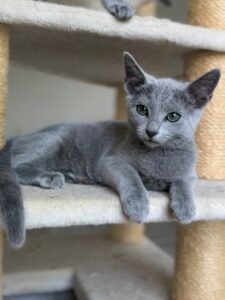

At first glance they look like cousins: round faces, round eyes, dense coats and calm natures. Both are quiet, affectionate cats that suit indoor life and settled households. But the Scottish Fold and the British Shorthair are very different breeds underneath, and the most important difference is not temperament or grooming — it is the Fold’s ears, and what causes them. This comparison covers origins, temperament, health and daily care, including the welfare facts about Scottish Folds every buyer should understand first.
Origins and appearance
The Scottish Fold began in Scotland in the 1960s, with a barn cat named Susie whose ears folded forward. The folded ear is caused by a naturally occurring gene mutation affecting cartilage throughout the body, not only in the ears. That is the defining fact of the breed, and it shapes everything else about it. The Fold is a medium-sized cat with a rounded head, large round eyes, a short nose and a dense, plush coat. It is best known for its round, owl-like face, its quiet voice, and its habit of sitting upright with its legs stretched out in front of it, a pose owners call the “Buddha sit”.
The British Shorthair is a much older breed, developed in Britain over centuries and refined into the cat we know today. It is a large, powerfully built cat with a broad chest, a round head, full cheeks, large round copper or gold eyes and a short, dense, plush coat that stands away from the body. The blue-grey coat is the classic colour, but the breed comes in many colours and patterns. Adult males commonly weigh 5–9 kg, females somewhat less. The breed is often described as having a “Cheshire cat” smile, from the slight upward curve of its mouth.
Both breeds are recognised by TICA and the CFA. The Scottish Fold is not recognised by FIFe or the GCCF, which do not accept it because of the health implications of the folded-ear gene.
Temperament: the quiet companion and the calm independent
Both breeds are calm, quiet and affectionate, and both suit indoor life well. The difference is in how they ask for attention.
The Scottish Fold is a gentle, even-tempered cat that bonds closely with its people. Folds are famously undemanding: they are happy to sit beside you rather than on you, they follow their owners from room to room, and they use their soft, quiet voice sparingly. They are usually good with respectful children and with other cats and cat-friendly dogs, and they adapt well to a calm household. They are playful but not hyperactive, and they enjoy interactive play without needing constant entertainment.
The British Shorthair is calm and dignified in a more independent way. It is affectionate and loyal, but it is not a lap cat by nature: it prefers to sit near you rather than on you, and it dislikes being picked up and carried. It is happiest in a settled, predictable household, tolerates being alone during a normal working day better than most breeds, and is usually good with respectful children and other pets. It plays in short bursts and is not a demanding or noisy cat.
In practice, the Fold asks a little more of your company, while the British Shorthair asks a little more of your respect for its space.
The welfare facts about Scottish Folds
This is the part of the comparison that matters most.
The folded ear is caused by a mutation in a gene affecting cartilage development. The condition is called osteochondrodysplasia: the cartilage throughout the cat’s body does not develop normally, which affects the ears and can also affect the joints, particularly the tail, ankles and knees. All Scottish Folds carry this mutation, and all are affected to some degree, though the severity varies from cat to cat. Some Folds develop painful degenerative joint disease, with stiffness, lameness and reluctance to jump or climb; others show milder signs. There is no way to guarantee a Fold will be free of joint problems.
Responsible breeding practice reflects this: breeding two folded-ear cats together is widely discouraged, because it increases the severity of the cartilage defect in the kittens. Responsible breeders mate a Fold to a straight-eared cat and monitor their cats for signs of joint disease, but the risk cannot be removed entirely — the fold itself is the visible sign of the cartilage condition.
This is why some registries and veterinary bodies advise against the breed, and why breeding Scottish Folds is prohibited in some countries — including the Netherlands, where breeding fold-eared cats is banned. Anyone considering a Scottish Fold should go in with open eyes: ask the breeder directly about joint health and movement in the parents, and about the veterinary checks they have had. A breeder who is honest about these risks is the only kind worth dealing with. If the risk is not one you are comfortable carrying for the lifetime of the cat, the British Shorthair — a naturally round-faced breed with no such condition — is the safer choice.
Health and screening to ask about
For the Scottish Fold, ask about joints and cartilage first: how do the parents move, have they shown stiffness or lameness, and what veterinary assessment have they had? Ask also about hypertrophic cardiomyopathy (HCM), the most common heart disease in cats, diagnosed by echocardiogram performed by a veterinary cardiologist.
For the British Shorthair, ask about HCM as well — the most important condition to screen for in the breed — and about polycystic kidney disease (PKD), for which a DNA test exists, plus the parents’ general health and veterinary history. No screening programme makes any cat “risk-free” — it reduces risk and shows the breeder is breeding carefully. Always ask to see the actual results for the actual parents (our guide to choosing a responsible breeder lists the questions to ask).
Coat and grooming
Both breeds have dense coats, but the grooming workload is modest for both.
The Scottish Fold’s coat is dense and plush, in short-haired or long-haired varieties. Weekly brushing is usually enough for the short-haired type, with more frequent grooming during shedding season; the long-haired type needs brushing several times a week to prevent matting. The Fold’s folded ears need a weekly check: the fold can trap wax and debris, so look inside the ears and clean them gently only if your vet has shown you how. Never force a folded ear open or clean deep inside it.
The British Shorthair’s coat is short, dense and crisp, shedding more heavily twice a year. Weekly brushing is usually enough for most of the year, with more frequent brushing during shedding season to keep loose hair under control. Routine claw trims, dental care and ear checks apply to both breeds.
Neither breed needs bathing as a routine, nor the daily grooming a long-coated breed like the Persian demands.
Energy, space and daily life
Both breeds are low-energy, indoor cats that are content with a calm household and a regular routine.
The Scottish Fold needs daily play and company: interactive play sessions, a scratching post, a comfortable perch by a window and puzzle feeders. It is not a great climber and does not need tall cat trees, but it does need space to stretch out, a warm spot to sleep, and — importantly — a home where its movement is watched. If a Fold becomes reluctant to jump, climb or play, mention it to a vet promptly — it can be an early sign of joint discomfort.
The British Shorthair needs less of your time but more of your respect: a quiet household, a comfortable bed, a scratching post, regular short play sessions and a predictable feeding routine. It copes well with being alone during the day, and it does not need a large home — but it does need space to move comfortably, given its size, and a sturdy cat tree it can use without wobbling.
Both breeds should be indoor cats or have secured outdoor access — both are trusting, unstreetwise cats, poor candidates for free roaming.
Living with families and other pets
Both breeds are known for being good with families, but in different ways.
The Scottish Fold is patient and tolerant, usually good with respectful children and with other cats and cat-friendly dogs when introduced properly, and it usually enjoys company — including the company of another cat.
The British Shorthair is also patient and tolerant with respectful children, and it usually gets on well with other cats and cat-friendly dogs. It is one of the breeds most likely to be content in a household where people are out during the day. Both breeds need introductions to children and other pets done slowly and calmly, as our guide to introducing a new kitten explains.
Which one fits you?
- Choose a Scottish Fold if you want a quiet, gentle, owl-faced companion that will sit beside you and follow you around — and you accept the joint-health risk that comes with the folded ear and are prepared to watch your cat’s movement and work with a vet over its lifetime.
- Choose a British Shorthair if you want a calm, dignified, independent cat with the same round-faced charm, a plush coat and a low-maintenance routine — a breed with no known cartilage condition attached to its defining feature.
Still deciding? Read the full breed guides for the Scottish Fold and British Shorthair — and if you are considering a kitten, start with an enquiry and an honest conversation about your household and how much time you can give every week. The right match matters more than the fastest one.