The Bengal looks like a small leopard and behaves like one too — at least when it comes to energy. Beneath the rosetted coat is an athletic, clever, intensely social cat that needs real daily play, climbing space and something to think about. The good news is that the coat itself is one of the easiest of any pedigree breed to look after. This guide covers the Bengal’s energy, its coat, feeding, health screening and the home it needs, so you can decide honestly whether this breed fits your life.
The breed in brief
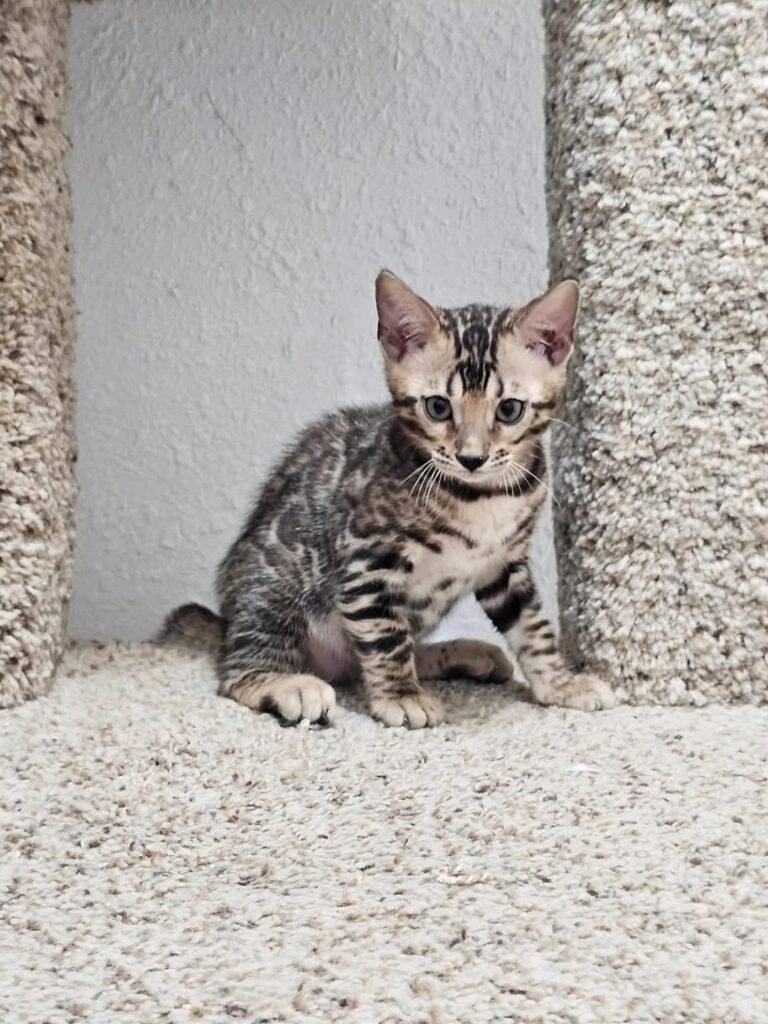
The Bengal was developed from crosses between the small wild Asian leopard cat and domestic cats, and has been refined over many generations into a fully domestic breed. It is a medium to large cat, typically 3.5–7 kg, long, sleek and heavily muscled, with hind legs slightly longer than the front legs and a thick, low-carried tail. The coat is short, dense and unusually soft, lying close like a pelt, and comes in rosetted or marbled patterns in brown, silver, snow and other colours. Many Bengals carry “glitter”, a sparkle at the hair tips that catches the light.
The Bengal is recognised by the major registries, including TICA, which granted championship status in 1991, the GCCF and FIFe; the CFA began registering Bengals in 2016. Only Bengals at least four or five generations removed from their wild ancestor qualify for championship showing, and ownership rules for early-generation hybrids vary by place — check local rules before committing to any Bengal.
The temperament is the defining feature: Bengals are confident, curious, vocal and dog-like in their attachment to people. They follow their owners from room to room, learn routines quickly, play fetch, and often show a famous fascination with water — splashing in bowls, joining their owner at the tap, sometimes even stepping into the shower. They are not a breed that sleeps the day away on a windowsill. A Bengal that is bored will invent its own entertainment, and you may not enjoy what it invents.
Energy and everyday play: the non-negotiable part
If there is one thing to understand before choosing a Bengal, it is this: daily play is not optional, and it is not a five-minute wave of a toy. Guides differ on the exact figure — some suggest at least 30 minutes of interactive play a day, others 45–60 minutes, and others an hour or more — but they agree on the shape of it: several sessions a day, spread across morning and evening, with the cat running, climbing, hunting and solving problems.
A practical routine is two or three interactive sessions a day, each 10–20 minutes, using wand toys worked like prey, small balls for fetch, and puzzle feeders that make the cat work for food. A tall cat tree, wall shelves or a climbing route that lets the cat get up high matters as much as the toys: Bengals are climbers by nature and need vertical territory, not just floor space. A cat exercise wheel suits some Bengals well, and a secure catio or harness walks — introduced slowly, with a properly fitted harness — give an outlet for the breed’s curiosity about the outdoors.
Training is part of the play routine, not separate from it. Bengals learn fast and enjoy it: clicker training with small food rewards teaches sit, high five, spin, fetch and recall, and it channels energy that would otherwise go into mischief. Start training young, keep sessions short and positive, and end on a success.
The warning signs of an under-stimulated Bengal are easy to spot: restless pacing, excessive vocalising, scratching furniture, knocking things off shelves, and ambushing ankles. These are not “bad behaviour” — they are a bored athlete asking for work. If no one at home can give a Bengal real daily play and climbing space, this is not the breed for you. Skip a Bengal if no one at home can give it real daily play and climbing space — a quiet lap cat it is not.
The coat: the easy part
After all that energy, the coat is a relief. The Bengal’s short, dense, pelt-like coat sheds less than most shorthairs and rarely mats. A weekly brush with a soft bristle brush or a rubber grooming mitt removes loose hair and spreads the coat’s natural oils — five minutes is usually enough, and many Bengals treat brushing as a game.
Baths are rarely needed unless the cat has rolled in something, though plenty of Bengals will walk into the tub voluntarily. If you do bathe one, use a shampoo made for cats, rinse thoroughly and dry the cat well. A dull coat is worth a vet visit: the glitter and sheen depend partly on diet and general health, so a coat that suddenly loses its shine can be an early sign that something is off.
The rest of the routine is the same as for any cat, but it matters more with an active breed: trim the claws every two to three weeks — Bengal claws are strong and grow fast — check the ears weekly and clean them only if there is visible debris, and brush the teeth several times a week with cat-safe toothpaste. Because Bengals play hard, check paws and skin after play for scrapes.
Feeding and weight
A Bengal is a lean, muscular athlete and should look like one, with a visible waist and ribs that are easy to feel under a thin layer of fat. Feed a good-quality complete cat food in measured amounts, following the feeding guide for the cat’s weight and age, and keep treats small. Because Bengals have a high metabolism and a strong food drive, several small meals a day — or food delivered through puzzle feeders — work better than one large bowl left down all day, and they turn feeding into enrichment at the same time.
Fresh water should always be available. Many Bengals prefer a wide bowl, and some will drink more from a fountain — worth trying if your cat seems to drink little. Weigh your cat regularly and ask your vet whether its weight is right; an overweight Bengal loses the athleticism the breed is built for, and extra weight puts strain on joints.
Health and screening to ask about
Responsible breeders screen breeding cats for the hereditary conditions relevant to the breed, and the questions to ask differ by breed.
For the Bengal, the conditions most often discussed are hypertrophic cardiomyopathy (HCM), the most common heart disease in cats, diagnosed by echocardiogram performed by a veterinary cardiologist; Bengal progressive retinal atrophy (PRA-b), an inherited eye condition for which a DNA test exists; and pyruvate kinase deficiency (PK-def), an inherited red blood cell condition that also has a DNA test. Ask also about patellar luxation and hip dysplasia, which are reported in the breed.
No screening programme makes any cat “risk-free” — it reduces risk and shows the breeder is breeding carefully. Always ask to see the actual results for the actual parents (our guide to choosing a responsible breeder lists the questions to ask). A vet who sees the cat at least once a year — more often as it ages — is part of the care routine, not an emergency measure. Bengals commonly live 12–16 years.
The home a Bengal needs
A Bengal needs an active, engaged home. It does not need a large house, but it does need height: tall climbing furniture, shelves, and safe perches by windows. It needs company — Bengals do best in homes where someone is around for much of the day, and many do well with another cat or a cat-friendly dog as a companion, provided introductions are done gradually. A home where everyone is out all day rarely suits a Bengal unless the cat has a companion and a well-enriched environment to come home to.
Bengals are usually good with respectful children and with other pets, and they adapt well to a household with a normal working routine — as long as someone is there to play. They are vocal cats: they chirp, trill and talk to their owners, and they expect an answer. If you want a quiet, undemanding cat, this is not it.
Because Bengals are clever, kitten-proof the home properly: secure cupboards, hide cables, and keep small objects out of reach. A Bengal will open doors, learn how drawers work and find the one fragile thing on the shelf. Our kitten FAQ covers the basics of bringing a kitten home safely.
Is a Bengal right for you?
- Choose a Bengal if you want an athletic, interactive companion, you enjoy daily play and training, and you can offer climbing space, puzzle feeders and real company every day.
- Think again if you want a low-energy lap cat, you are away all day, you have no room for tall climbing furniture, or you want a quiet household.
Still deciding? Read the full breed guide for the Bengal (/bengalscatspage/) — and if you are considering a kitten, start with an enquiry and an honest conversation about your household, your working hours and how much play time you can give every single day. The right match matters more than the fastest one. If you have general questions about bringing a kitten home, our kitten FAQ (/kitten-faq/) covers the basics.