
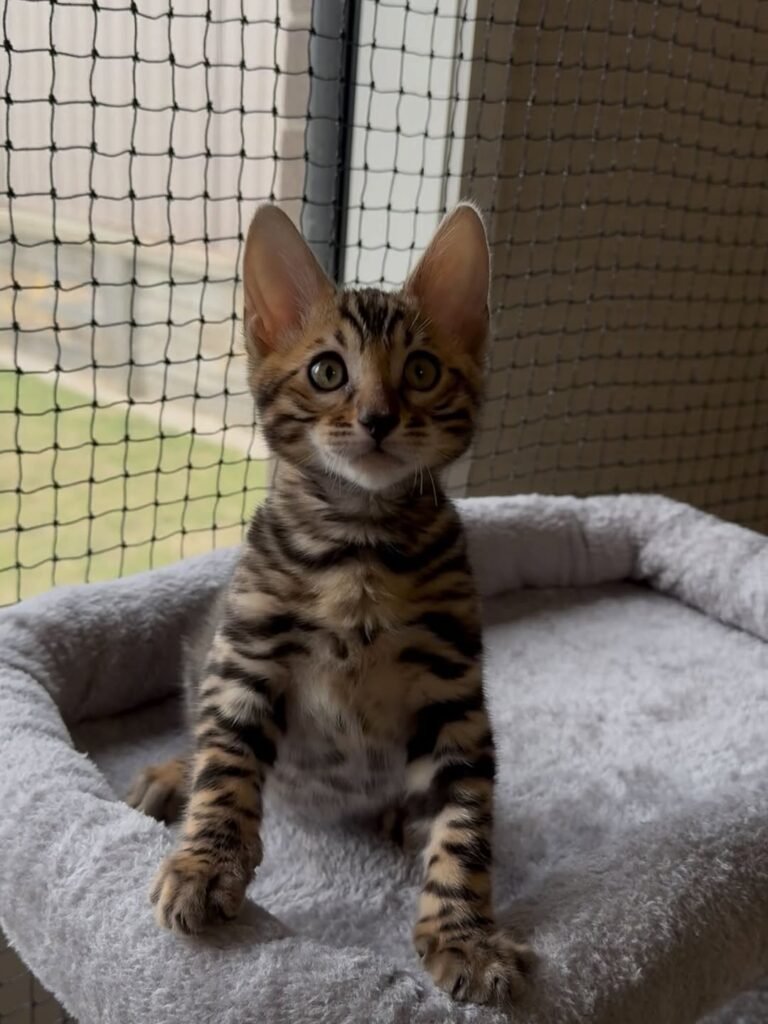
The Bengal is the athlete of the cat world. Bred from the Asian leopard cat and the domestic cat, it kept the wild ancestor’s build — long, muscular, and built for climbing and jumping — and its energy. A Bengal does not just like to play; it needs to play, every day, or it finds its own entertainment. And a bored Bengal’s entertainment is usually your curtains, your shelves, and anything that can be knocked off a table.
That is not bad behaviour. It is a high-energy, intelligent breed doing what it was built to do, in a home that is not giving it enough to do. The good news is that a Bengal kept indoors can be perfectly happy — provided its home is set up for a cat that climbs, hunts, solves problems and talks back. This is a guide to what that takes.
How much energy does a Bengal actually have?
More than most breeds, and for longer. Bengals stay playful well into adulthood, where many breeds slow down after their first year. Expect a Bengal to want active play several times a day, not one sleepy session in the evening. A typical day for a happy indoor Bengal includes two or three proper play sessions of ten to fifteen minutes each, plus climbing, exploring and puzzle-solving in between — and a Bengal that gets that is far more likely to settle calmly in the evening than one that has spent the day with nothing to do.
The signs of a Bengal that is not getting enough stimulation are easy to read, and they are the same signs owners often mistake for naughtiness: racing around the house at 3 a.m., climbing the curtains, opening cupboards, knocking things off shelves, chewing things it should not chew, and demanding attention loudly and persistently. A Bengal that is getting enough play and enrichment still does some of those things — it is a Bengal — but far less often, and it settles more easily.
Bengals are also famously vocal. They chirp, trill and talk to their owners in a way that surprises people used to quieter breeds. That chattiness is normal for the breed. It is not a problem to fix, though a Bengal that is yowling constantly, especially at night, may be telling you it is bored or under-stimulated during the day.
Play: the daily non-negotiable
Play is the single most important part of a Bengal’s day, and it needs to be the right kind of play. Bengals are hunters, and the play they enjoy most is play that lets them hunt: stalk, chase, pounce and catch.
- Wand toys are the best tool for this. A feather or toy on a string, moved like prey — darting, hiding behind furniture, pausing and then running — lets a Bengal stalk and pounce properly. Move it away from the cat, not towards it; prey runs away.
- End each session with a catch. A hunt that never ends in a catch is frustrating. Let the Bengal catch the toy at the end of the session, then offer a small treat or a meal. Hunt, catch, eat, rest — that is the natural sequence, and following it helps the cat settle.
- Vary the toys. A Bengal that has seen the same toy every day for a month is bored of it. Rotate toys so there is always something new, and keep a few in a drawer to bring out in rotation.
- Do not use your hands as toys. A kitten that learns hands are for biting becomes an adult that bites hands. Hands are for stroking, toys are for hunting.
- Play before bed. A good play session in the evening, followed by a small meal, is the best way to get a Bengal to sleep through the night rather than holding the 3 a.m. Olympics.
Ten to fifteen minutes, two or three times a day, is a realistic target for most owners. If you work long hours, a morning session and an evening session, plus enrichment the cat can use alone during the day, will cover it.
Climbing: give the Bengal height
Bengals climb. It is not a quirk; it is how the breed is built. A home without vertical space for a Bengal is like a home without a scratching post for any cat — the need does not go away, it just finds the wrong outlet.
A tall cat tree — ideally one that reaches close to the ceiling, with several platforms — is the single best purchase for an indoor Bengal. Wall-mounted shelves and walkways are even better, because they let the cat travel around the room at height without taking up floor space. A perch by a window is a favourite: a Bengal will spend hours watching birds and the street from a high window seat, and that watching is enrichment in itself.
Make the high places safe. Shelves need to be firmly fixed and wide enough for a large cat to turn on. Anything breakable should not be on a shelf a Bengal can reach — because it will reach it. And give the cat a way down as well as a way up: a Bengal that jumps up easily but cannot get down gracefully will find its own route, usually over something fragile.
Enrichment: a bored Bengal is a destructive Bengal
Play and climbing cover the body. Enrichment covers the mind, and Bengals have more mind than most breeds. They learn quickly, get bored quickly, and enjoy solving problems. A home that gives a Bengal things to work out is a home with a calmer cat.
- Puzzle feeders are the easiest win. Instead of eating from a bowl, the cat has to work food out of a puzzle, a ball with holes, or a mat with hidden treats. It slows down eating, engages the brain, and turns a meal into an activity. Start easy — a Bengal that cannot solve a puzzle at all will just give up — and make it harder over time.
- Scatter feeding works too: hide small portions of dry food around the house so the cat has to hunt for its meals, the way it would hunt in the wild.
- Clicker training suits Bengals unusually well. They learn fast, they like the interaction, and teaching a Bengal to sit, come, high-five or walk on a harness gives it a job to do. Five minutes of training is as tiring for a Bengal as a much longer play session, because it uses the brain.
- Water play is a Bengal quirk worth knowing about. Many Bengals are fascinated by water — they will paw at a dripping tap, play in a shallow bowl, or try to join you in the shower. A shallow tray of water with floating toys, or a pet water fountain, can keep a Bengal occupied for a long time. Never force a cat into water, but if yours is interested, let it play.
- Rotate the environment. Move a cat tree, swap the toys, put a cardboard box in a new place. A Bengal notices change, and a small change is a small adventure.
Living with a Bengal indoors
A Bengal can live happily indoors — in fact, for a breed this valuable, athletic and curious, indoors is usually the safer choice, and it is the choice most breeders recommend. But indoors has to mean enriched indoors, not just indoors. A Bengal in a flat with one scratching post, one toy and nothing to climb is a bored Bengal, and a bored Bengal is the one that wrecks the curtains.
A few practical points for indoor Bengal life:
- Scratching is non-negotiable. Bengals scratch a lot, and they need tall, sturdy scratching posts — tall enough to stretch fully up — in the rooms where they spend time. A post that wobbles or is too short will be ignored in favour of the sofa.
- Keep the home Bengal-proof. Secure cupboards, keep small objects and medicines out of reach, and assume the cat can open anything it can reach. A Bengal that learns to open a cupboard will open it every day.
- Give it company. Bengals are social cats and bond closely with their people. A Bengal left alone for very long hours every day will be unhappy, however many toys it has. If your household is out all day, consider whether a second cat — ideally another active breed, introduced properly — would suit, or whether your schedule can give the Bengal the company it needs.
- Respect the noise. Bengals talk. If you want a quiet, undemanding cat, a Bengal is the wrong breed. If you enjoy a cat that greets you, follows you around and tells you what it thinks, it is exactly the right one.
Is a Bengal right for your home?
A Bengal is not a beginner’s cat, and it is not a cat for a home that wants a decoration. It is a cat for someone who enjoys playing with a cat, training a cat, and building a home a cat can climb around. If that sounds like you, a Bengal will be the most entertaining companion you have ever had. If it sounds like a lot of work, it is — but it is the work that makes the breed what it is.
If you are considering a Bengal, start with our Bengal kittens page to see the breed, and read our guide to choosing a responsible breeder before you reserve any kitten. The right questions, asked before you reserve, are what turn an energetic breed into a happy, settled companion.